

On Our Way
America takes steps toward a return to the Moon. It's about time.

If you’ve been reading me for a while, you know I’m not a huge fan of the Artemis mission, and particularly not a fan of its SLS booster. Both are too expensive and too unreliable to form a foundation for lunar settlement. The mission itself is fine; a rerun of the Apollo 8 circumlunar mission in some ways, but after over 50 years of nothing, getting back to things we did in the sixties counts as progress.
As one insightful commentator put it:
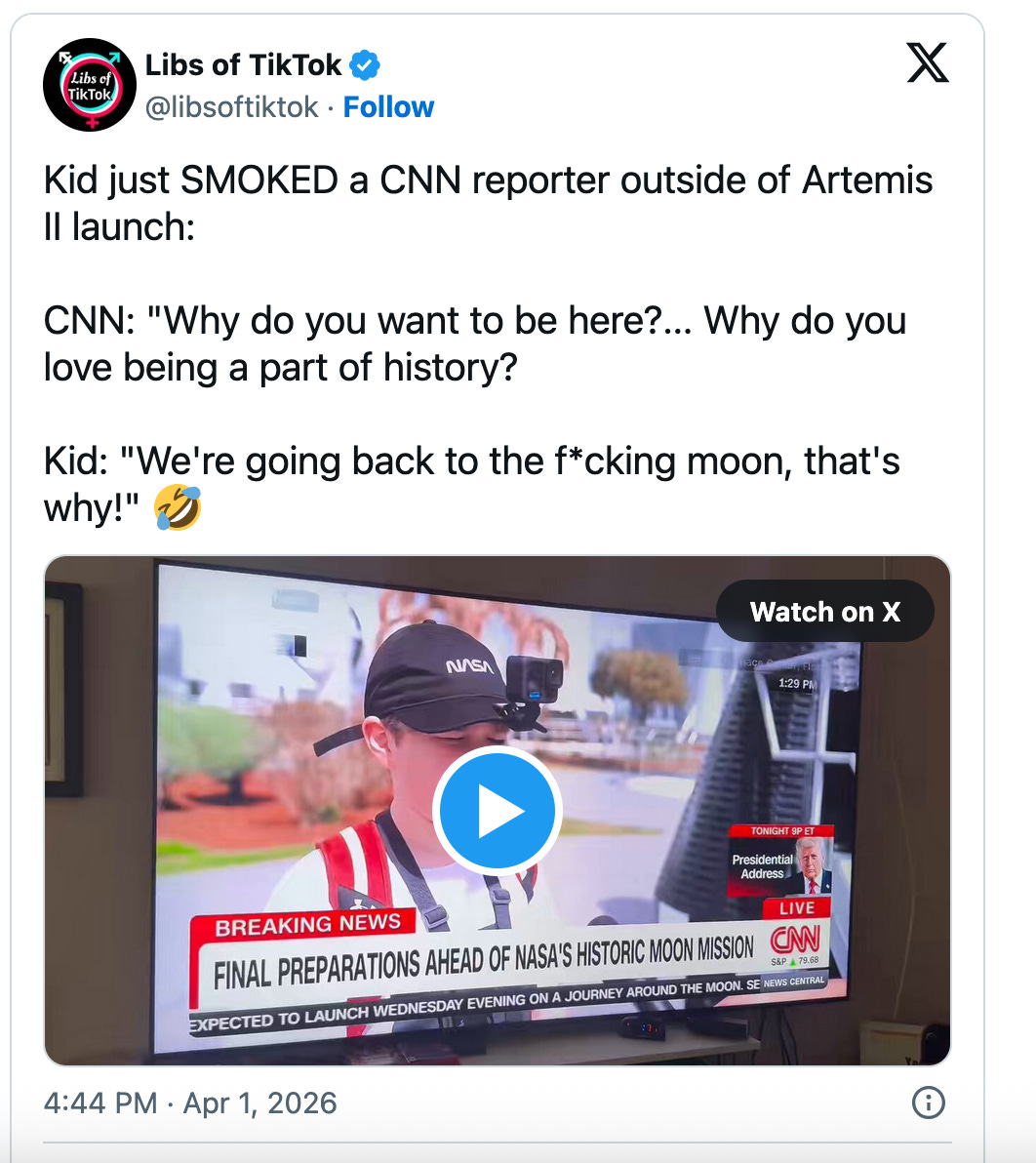
To quote Joe Biden regarding a much less significant program, “This is a big fucking deal.”
Why is it a big deal? Because:
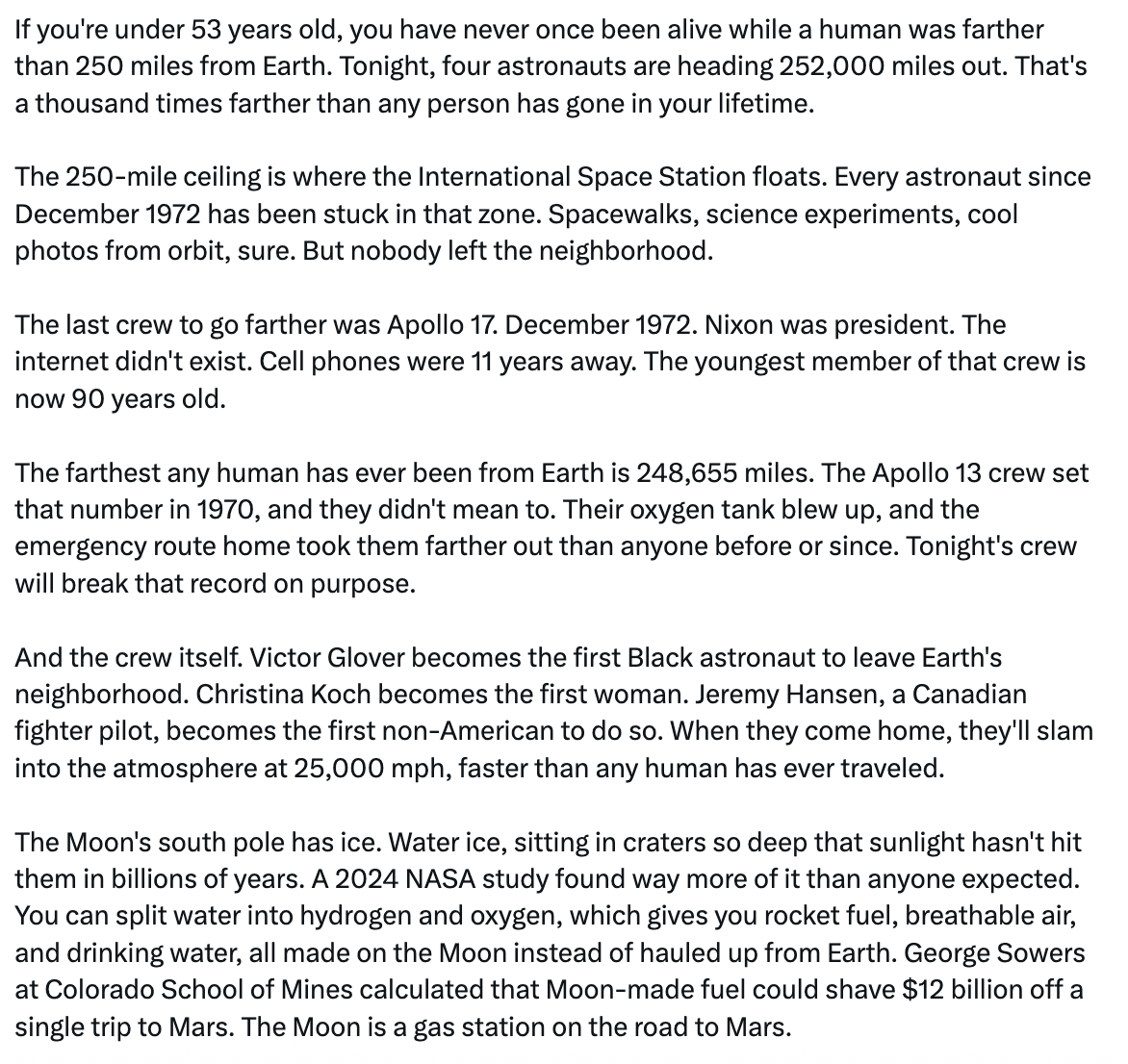
That’s right. Trump made it clear in his post-launch speech that were were going back, and we were going back to stay this time. And we’re having fun with it.
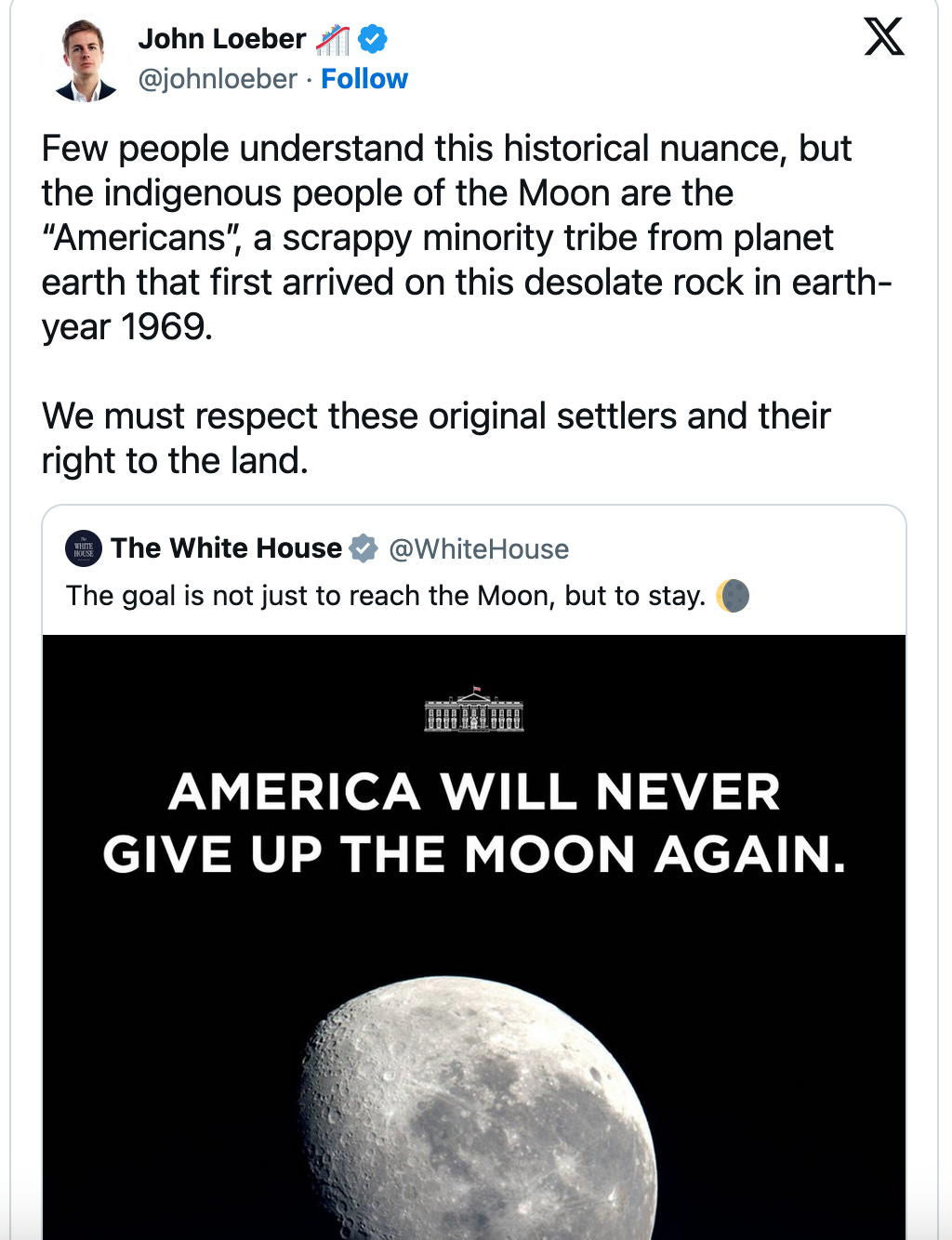

But all fun aside, it’s a big deal. Artemis is mostly a bureaucratic boondoggle; other rockets will actually get us moon colonies, probably various flavors of SpaceX’s Starship. But it’s a kickstart for enthusiasm.
And it turns out that there was a lot out there. The post-Apollo withdrawal from the Moon, and from serious space occupations, was a withdrawal from the frontier. That was a blow to Americans’ psyche. America is a frontier nation, and does best when it’s settling a frontier. (People who don’t like America know that, which is why they rush to dump on space activities, every time.)
The Western frontier didn’t just provide jobs for cowboys and prospectors. Even the society back on the East Coast got a boost of energy from the sense of open horizons. Where traditional societies saw wealth as a zero sum game, something to be divided, the frontier encouraged Americans to think of wealth as a positive sum game, where the amount on the table could be expanded through bravery and enterprise. The frontier was a source of societal energy and enthusiasm.
Many Americans understand that instinctively, and are cheering the flight. By now, if we had followed the trajectory we were on in 1968 when Apollo 8 flew, we would have colonies on the Moon and on Mars. We’re getting there now, a lifetime (basically, my lifetime) later, but we’re getting there, and Elon’s approach is likely to be more readily sustainable than what NASA was planning back then.
People are excited about this, and they should be. Better late than never.
think it should be a private operation. will be more efficient, and we will get there faster. like the department of education, NASA is probably not needed anymore
“If you’re under 53 years old, you have never once been alive while a human was farther than 250 miles from Earth.”
This is not true. Jared Isaacman was 870 miles from Earth less than 2 years ago.