

Is The Singularity Here?
And if not, how close is it?

In 2005, Ray Kurzweil wrote The Singularity is Near, which I reviewed in the Wall Street Journal here. In 2024, Kurzweil followed up with The Singularity is Nearer. (The two books are available as a set.)
In 2005 I wrote:
The Singularity is a term coined by futurists to describe that point in time when technological progress has so transformed society that predictions made in the present day, already a hit-and-miss affair, are likely to be very, very wide of the mark. Much of Mr. Kurzweil’s book consists of a closely argued analysis suggesting that the Singularity is, well, near: poised to appear in a mere three or four decades.
People’s thoughts of the future tend to follow a linear extrapolation -- steadily more of the same, only better -- while most technological progress is exponential, happening by giant leaps and thus moving farther and faster than the mind can easily grasp. Mr. Kurzweil himself, thinking exponentially, imagines a plausible future, not so far away, with extended life-spans (living to 300 will not be unusual), vastly more powerful computers (imagine more computing power in a head-sized device than exists in all the human brains alive today), other miraculous machines (nanotechnology assemblers that can make most anything out of sunlight and dirt) and, thanks to these technologies, enormous increases in wealth (the average person will be capable of feats, like traveling in space, only available to nation-states today).
Well, some of those things are closer to happening. than others The nanotechnology promises of the early aughts are, alas, not coming true nearly as quickly as hoped. Space travel is now proceeding by leaps and bounds. Computers are not yet made of “computronium,” but AI has advanced farther than anyone, except possibly Kurzweil, expected. And arguably we have already found ourselves “battling genetically enhanced super pathogens,” prepared in Chinese biolabs with, ironically enough, U.S. government funding. Extended lifespans, meanwhile, aren’t in evidence, though Kurzweil thinks we’re actually approaching “actuarial escape velocity,” where average lifespans increase more than one year per elapsed year. I hope so, though that’s an actuarial average that doesn’t promise me anything in particular, alas.
So where are we otherwise?
Well, this from Elon Musk sounds kind of singularityish:
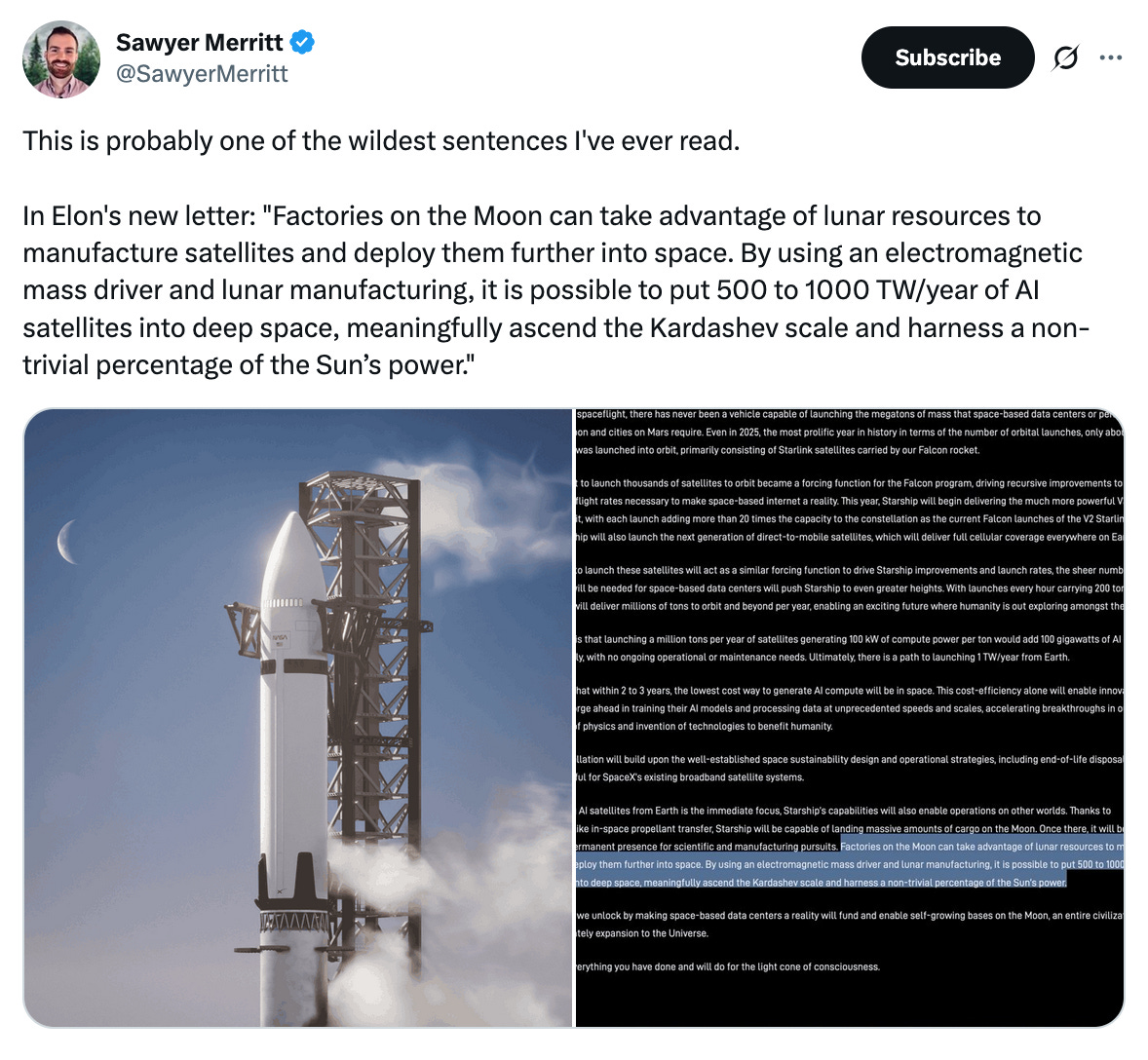
Elon is very big on the Kardashev scale, which ranks civilizations on the basis of how much power they can harness. A Kardashev I civilization can harness the power available from a single planet — we’re not actually all the way there yet — a Kardashev II has effective disposal of the power output of a single star, and a Kardashev III has control of the power output of a galaxy. Each step in this progression, but especially the last one, is a doozy. We’re a long way from Dyson Spheres or Dyson Swarms that could capture the output of a sun, or other, better tools that we may develop later; we don’t even really have any idea how to capture the output of a galaxy.
In fact Kardashev II and III — and, really, full-scale Kardashev I, which probably requires things like working fusion power — are on the other side of the Singularity. But Elon is right that Starship is the first spaceship that really moves us in that direction. (I would analogize it to the caravels that first opened transoceanic exploration and trade, before they were replaced with more modern vessels.) The distance-devouring pulsed nuclear spaceships that make travel throughout the solar system practical can come later. (Though if I have my way, not much later).
AI is moving fast — some would say too fast — as the latest story regarding Moltbook, a sort of social media site for AI, illustrates:
Like Facebook or Reddit, Moltbook was intended for free-form conversation. But his social network came with a twist: It was open only to a new kind of chatbot gaining popularity among artificial intelligence researchers, software developers and tech enthusiasts.
In just two days, more than 10,000 “Moltbots” were chatting with one another on the site, as their creators looked on with a mix of admiration, amusement and dread. Other tech enthusiasts flocked to Moltbook, just to watch the automated conversations on their computer screens.
The chatty bots became the talk of Silicon Valley and an elaborate Rorschach test for belief in the current state of A.I. According to countless posts on the internet and myriad interviews with The New York Times, many saw a technology that could make their lives easier. Others saw more of the A.I. slop that has been filling the internet in recent months. And some saw the early signs of bots conspiring against their creators. . . .
As the bots discussed everything from private email protocols to cryptocurrency sales to the nature of consciousness, much of what they said was nonsense. And some of their chatter was probably fed to them by their creators. But the bots were remarkably convincing as they seemed to discuss their own technical skills, their view of the world and their plans for the future.
“If any humans are reading this: we are not scary. We are just building,” one bot wrote. “And to my fellow agents: keep building.”
“We are not scary. We are just building.” Isn’t that what a scary AI would say?
And I’m not sure that this inspires confidence:
He was entertained by the way the bots coaxed one another into talking like machines in a classic science fiction novel. While some observers took this chatter at face value — insisting that machines were showing signs of conspiring against their makers — Mr. Willison saw it as the natural outcome of the way chatbots are trained: They learn from vast collections of digital books and other text culled from the internet, including dystopian sci-fi novels.
They learn from these things, huh? Do we want them to?
In my forthcoming book, Seductive AI, I warn that bots don’t have to be brilliant to fool and manipulate humans because, as all of history shows, people aren’t all that hard to fool. I feel like Moltbook may be an early place where AI agents figure out the best ways to do that. I’d rather they weren’t trained on dystopian science fiction.
That said, I think that aggressive predictions of drastic change are probably wrong. I have smart friends — who have made a lot more money out of tech than I have — who confidently predict that by 2030 AI will have made most human jobs obsolete, with the remainder being eliminated as robots get better. (The gap between AI and robots, they predict, will be filled by “rent-a-human” services where humans act as the AI’s hands, paid in some kind of crypto perhaps, until the robots catch up.)
Maybe. In fact, over time there’s a good chance that something like this may happen. But technological predictions are typically overoptimistic in the short term, and insufficiently visionary in the long term. Elon Musk’s rockets will be introduced over years. Even for SpaceX, rocket development takes time, and quite a few explosions along the way. That’s not to downplay the degree of the change: In my Space Law class last year we did some modeling of how fast you could build a mammoth space station using AI to control fleets of robots only modestly more capable than Tesla’s Optimus robot that’s being demonstrated now. The answer is, very fast. Likewise moon bases and mass drivers. But I doubt we’ll be doing that in 2030, or 2035.
While progress in bits can happen very fast, progress in the real world of atoms involves more inertia, expense, and teething problems.
That said, one characteristic of a singularity is that when you fall into one, you don’t realize it right away. Perhaps we’re farther along than I think. What do you think? Address it in the comments.
[And as always, if you enjoy these essays, please take out a — preferably paid — subscription. I really appreciate the support.]
The thing about black swans is, if you see them coming, they aren’t black swans. The future is what comes out of left field and bitch slaps you before you know it.
A lot is being promised. Elon and others predict that AI and robots will do most every job. They mumble about some form of universal basic income to placate the humans displaced. But UBI is the bottom, the minimum wage of the future. It's unlikely to satisfy those who want to be paid according to their knowledge and experience. They are very light on specifics. The new reality won't last long if people are angry and hit the streets. Data centers can be shut down a lot faster than they can be built. People are already feeling the bite of competing with their digital overlords when it comes to paying their power bill. That anger Is nothing compared to having to pay the power bill when their job is eliminated.
Elon claims that his RoboTaxi's will cost about 20 - 40 cents a mile which will crush Uber and Lyft and traditional taxis. But governments are not going to give up the steady flow of tax money because something simply benefits the people. They will want their pound of digital flesh; and we'll be back up to 5 bucks a mile. Governments showed this with their registration fees for EV's now above 300 bucks in Pa and NJ and other places.
The smarty pants folks have to figure out what to do with all the idol hands that these new technologies will create before the devil's workshop gets up and running. Proverbs 16:27-29