

And Away We Go!
Starship V.3's successful launch and return sets us on the path to a Kardashev II civilization.

“Damn, how I wish Jerry Pournelle could be watching this.”
That was a comment to a blog post I wrote on Friday’s successful SpaceX Starship v.3 launch. I wholeheartedly agree. When I was still a kid, I read Jerry’s column “A Step Farther Out” in Galaxy magazine religiously. Jerry saw it all coming: vertical takeoff and landing spaceships, the need to lower costs to orbit, and the absolute necessity for both reusability and launch volume to make things cheap enough, and reliable enough, to build an interplanetary economy. He wrote about the immense resources of space (both in terms of energy and material), and the wide-open human future they could support. As the blurb for a collection of his work published in 2022 says, “If you wanted a strategy for the technology of going to space in the 1970's, 80's and 90's, Dr. Jerry Pournelle was your man.”
I don’t know this firsthand, but I feel certain that he was a big influence on Elon Musk’s thinking.
Jerry saw it coming, and lived to see the beginning of SpaceX, but like Moses he saw the promised land but didn’t get to enter it.
Now, we’re about to enter it.
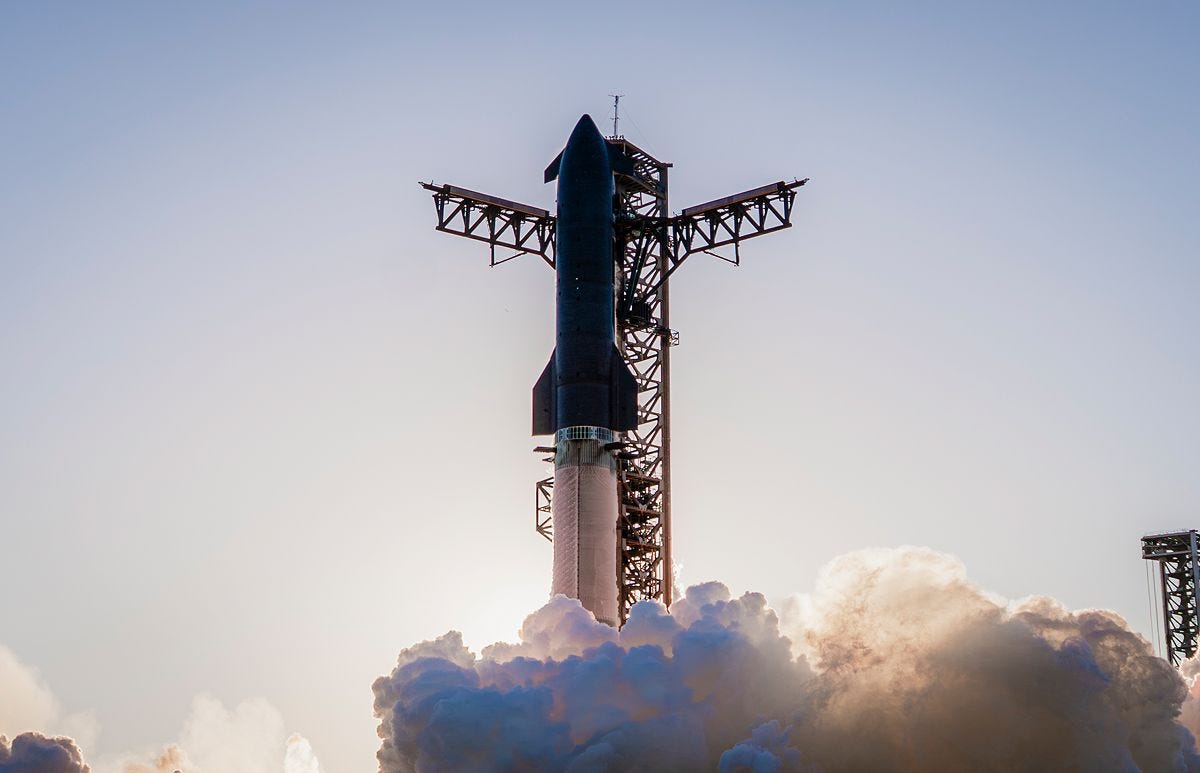
Image via SpaceX.
There are still bugs to work out, and capabilities to add, but what we saw on Friday was a full-fledged interplanetary spaceship. Starship v.3 is big enough to carry cargoes to the Moon and Mars. It uses methane fuel which — as Bob Zubrin demonstrated in the 1990s in support of his “Mars Direct” exploration/settlement architecture — can be manufactured on-site from the Martian atmosphere using 19th Century chemical technology. (I’m positive that Musk has studied Zubrin’s work carefully too.)
It will also support missions to asteroids, which are loaded with precious and valuable metals, carbon compounds, and other useful stuff. (Even rock is useful for radiation shielding, and using stuff that’s already in space is generally cheaper than launching it from Earth.)
A moon base is practical with Starship. Artemis, for all the hype, uses NASA’s SLS rocket, which is based on technology over half a century old — Congress mandated that it use Space Shuttle technology — and costs literally billions per launch.
Large structures in Earth orbit are practical with Starship. Elon wants to build data centers in orbit, and others are following his lead. (As I wrote decades ago, the first Earth explorers brought back spices because they had an enormous value-to-weight ratio; space-based communications is even better because photons don’t weigh anything. Computation is similar. Also, the anti-AI-data-center movement on Earth is just playing into his hands.) Space solar power plants, converting the 24-hour, unfiltered sunlight of outer space into electricity that is beamed to Earth via microwave (a technology long-since demonstrated) are practical with Starship.
And it’s not just lift capacity. The Musk empire also stresses AI and robotics. When we were thinking about large space structures in the 1970s we assumed they’d be built by humans, like offshore oil rigs. In my Space Law seminar last fall we did some rough modeling on how much faster you could build them using robots controlled by AI. The answer was rough, but clear: Much, much faster. And more cheaply, and without labor issues.
Elon’s other company, The Boring Company, which specializes in tunneling, is often forgotten, but it’s actually revolutionary in itself. And you know what you need for bases and colonies on the moon and Mars? Tunnels. Lots of tunnels. (Also, later, for asteroid habitats.)
It’s like he’s been thinking about this stuff all along. It’s like that because he has.
You can sort of imagine what he’s been doing as like a rocket. Tesla was the booster, which brought in a lot of money, created a lot of manufacturing expertise, and built credibility. SpaceX/Falcon and Starlink were the second stage. Elon built a rocket company with a better, cheaper rocket, but to refine things and cut costs you need launch volume. There weren’t enough customers to provide that volume, so he created his own customer with Starlink, which is now SpaceX’s biggest moneymaker.
In the early days of Starship, he’ll supply transportation for NASA once it gives up on SLS. (It needs another flight or two so they can pretend it wasn’t a failure, then they’ll fold it up. Everyone in the field has known this for a while.) But the moon base will be built with Starship lift, not recycled Shuttle tech.
Data centers will do for Starship what Starlink did for Falcon, providing the necessary launch volume to be economical. Meanwhile Mars flights will begin. Asteroid exploration is still far away enough to be left to NASA, which has a mission going to Psyche, which appears to be an enormously rich asteroid, right now. Serious commercial exploration/exploitation will follow, either by SpaceX or by one of several startups that have already appeared. (In fact, we had an asteroid-mining tech bubble over a decade ago, but it was too early to get off the ground, so to speak.)
Large structures in Earth orbit will ultimately be built with materials from the Moon and the asteroids more than with materials from Earth. They may be delivered from the Moon to Earth orbit
None of this would surprise Jerry Pournelle, though it’s surprising how few of Elon’s critics — and even of his boosters — really grasp the extent and integration of the plan here.
There’s another thing that would make Jerry happy.
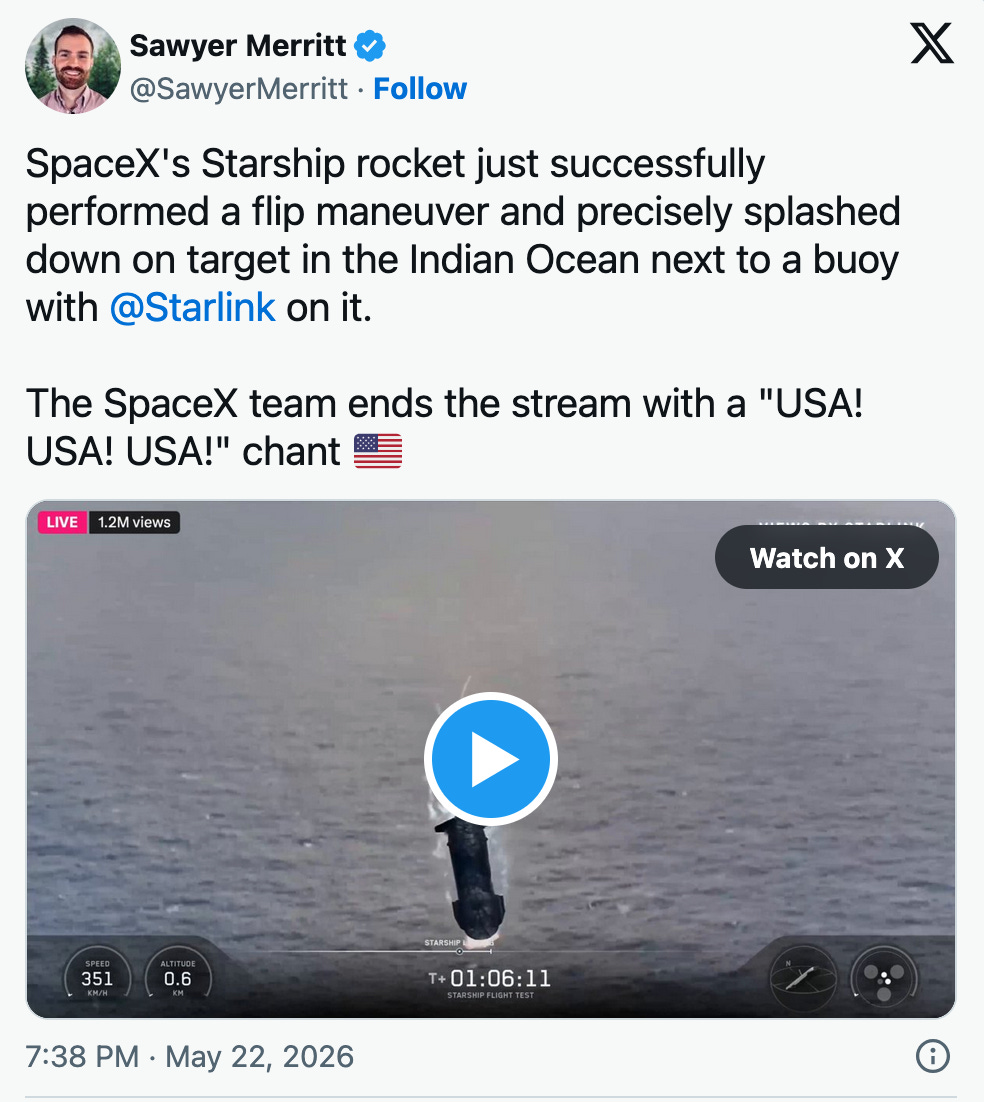
After the mission concluded, the SpaceX crew was chanting “USA! USA!” Jerry always said that it was nearly certain that space would ultimately be settled by humans, but that it would make a big difference which humans got there first. The USA is the planet’s beacon of freedom and hope — and, frankly, the only country that could have supported the development of a company like SpaceX, with a freewheeling and creative yet utterly results-oriented culture. If we get there first, the coming millennium will look very different than it would if it was, say, China who got there first. (And speaking of culture, one of the largely untold stories is how Elon Musk has managed to hire so many utterly competent people, both engineers and non-engineers for his companies. I think a lot of it is that he gives them important things to do and doesn’t bother them with bullshit. People are willing to work very hard indeed for important results.)
The Kardashev scale was initially created by Soviet astronomer Nicolas Kardashev as a way of ranking civilizations by resources. A Kardashev I civilization has control of all the resources of a planet. (We aren’t there yet, we’re probably about a Kardashev 0.7). A Kardashev II civilization controls the resources of a solar system. A Kardashev III civilization, which we can’t really even imagine, would control the resources of a galaxy.
We aren’t even a Kardashev I yet, but Starship v.3 is an indication that we’re on the path to Kardashev II. That’s a promised land I won’t live to see — and neither will Elon, or probably anyone alive at the moment — but we are heading there, and will be there in a jiffy by human-historical standards. A huge accomplishment, made possible by a lot of hard work, smarts, and creativity. Ad Astra, per ardua!
“Damn, how I wish Jerry Pournelle could be watching this.”
Oh, he is. I'm morally certain of it.
While it's hard for me to appreciate "a promised land I won’t live to see," your infectiously optimistic view of these things actually stimulates interest I would otherwise never have had, which (for me, at least) is saying quite a lot.